Posts

Avaruddha-saurata

Image
Sampadananda Mishra Prishni shared some questions and answers about Sahajiyaism which she asked of an on-line AI program that almost instantly searches all the data available to it on the internet and is able to construct a human-like response, based purely on superpowered capacity to process information. It gave quite a good answer, but I recognized in it a kind of mechanical character: it was a collection of data points, pointing to agreements and disagreements with clinical evenhandedness. Nevertheless, Ii have to admit that it was an impressive overview of much of what has happened over a 500 or 1000-year history, something you would expect to get in a university world religions study course. It did not however show the life of a lived tradition. I do not doubt however that one could get the program to adapt to your particular preferences by refining your inquiries. For instance, you could ask, "Where can I learn about this and implement its practice in my own life, from a li...

It is good to be 73: Another life report

Image
A couple of days ago I wrote on Facebook: It is good to be 73. I feel as though everything I have done in my life is coming to a ripening. Eventually the fruits that have been growing for a lifetime start to ripen. Just as long as you water. Fortunately, I have had plenty of water, and still have, and hope to have more. I wasn't even thinking about my birthday when I wrote the above, though I suppose there must have been some subliminal processes going on. But it is more like a coming to terms with being in Canada and staying here for so long, something that was both unexpected and has been challenging. It is often hard to find a synthesis between the various worlds that one inhabits. The Vedic system always seeks to minimize disruption through simplification. The theory is that the sattva guna is the highest promoter of happiness and one should increase the sattva guṇa throughout life. It is not that growing old inevitably means only tamas. The varnashram concept sees a ni...

Bhagavad Gita classes: Where we are and what we are doing?

Image
श्रीमधुसूदनसरस्वतीपादानां गूढार्थदीपिका टीका अत्युपकारिणीति मन्ये । सा अतितरां विस्तृता पाण्डित्यपूर्णा गूढार्थप्रकाशिनी च । मम चिरदिनं तत्पिपठिषा वरीवर्तते । तस्माद् इदानीं गम्भीरानन्दस्वामीपादानां आंग्लानुवादं अवलम्ब्य अग्रेसर्तुमिच्छा वर्तते । आशासे तत् सर्वेषां संमतं । हरिः ॐ तत् सत्॥ We recently finished the fourth chapter in our daily Gita class that I am giving on Zoom. Up until now, we have been reading the Gita with three Sanskrit commentaries, those of  Sridhara, Vishwanatha and Baladeva. Occasionally we turned to Madhusudana Saraswati's Gūḍhārtha-dīpikā  for insight, but with the above message, I announced that beginning with the fifth chapter, we would read Madhusudan in his entirety as well.  Though I have long recognized the justifiable reputation of Madhusudana's commentary, we are generally not encouraged to read him because he is a known opponent of Vyasa Tirtha, the accarya of the Madhva line and senior contemporary of Chaitanya Mahaprabhu. He is, ergo, ...

What is night for one is day for the other

Image
When for every thing the night does break,  then the self-controlled are wide awake;  and when other creatures are roused to light,  for the introspective, it is the night. (Gita 2.69}  yā niśā sarva-bhūtānāṁ tasyāṁ jāgarti saṁyamī  yasyāṁ jāgrati bhūtāni sā niśā paśyato muneḥ   Not so long ago a young friend wrote a little piece on the ten things he had learned from his Krishna bhakti experience after a few years of chanting.First on his list was the benefit of getting up early in the morning and doing sadhana at that auspicious time of day. It is true that I got a taste in Iskcon for getting up at the Brahma Muhurta and doing bhajan before the sun comes up. I had fallen off a lot before I returned to India, but in Rishikesh I was an eager early riser and present in the meditation hall to enjoy the atmosphere alone at four in the morning or earlier. You get a taste for the darkness, which is truly a rarity in our Kaliyuga. Early rising a habit that ...

To students of my Sanskrit course

Image
Just imagine if you were brought up speaking Sanskrit. Do you think that you would have a different sort of brain? I have spent a lot of time thinking about the psychology of language and identity. Identity is central to raganuga bhakti, both on the level of the sadhaka deha and the siddha deha. I was thinking about this earlier (since in class I had mentioned that you more or less have to be crazy to want to learn Sanskrit). We were discussing this verse as an illustration of different classes of athematic verbs being used in the same sentence, all in the third person singular. The following verse has six verbs, each from a different class: ददाति प्रतिगृह्णाति गुह्यमाख्याति पृच्छति । भुङ्क्ते भोजायते चैव षड्विधं प्रीतिलक्षणम् ॥ One gives and accepts [one another’s gifts], one tells and inquires about one another’s private matters, one eats what the other offers and one invites the other to eat. These are the six kinds of signs of love. ( Upadeśāmṛta 4) Here √दा, ददाति (3P), √ग्रह्, गृ...

Gaura Sangha interview with Sarva Shakti Das

Image

Update

Image
I feel as though I am amiss if I don't give at least a brief report of what is going on here. It seems that I have gone through another long period of silence on the blog, which is not particularly good if you are "building" an audience. Or whatever it is that motivates us to engage in action of any kind. I have started teaching my two daily classes. It has changed my mood completely to be directly engaging with students and again trying to share my love of Sanskrit with them. The last couple of weeks I have been working on the manual again, mostly formatting, so that the students have a hard copy to scribble on. I am going to pick up the hard copy later this morning. Jiva Tirtha Sanskrit 7.5. After ten classes one student asked, Am I supposed to be memorizing this? Yes, my friends, I am afraid soPretty ambitious, I know. Foolish also. Anyway, I told my students that Panini was the first linguist and his analysis went quite far and influenced Indian thinkI have packed ...

Bhakti Sandarbha 40: Offenses Make One’s Heart Hard

Image
I started posting stuff from Bhakti Sandarbha starting from Anuccheda 178. This one was posted to Facebook on July 29, 2017, but not to the blog.

Compassion, Humility, Vrindavan Dham

Image
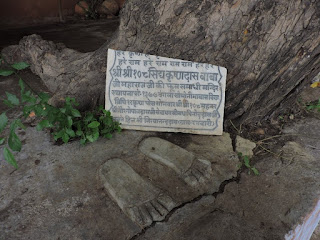
Today's memories are dominated by 2016 when I was more engaged in Vrindavan Today research and writing. It is too bad that the VT archives were lost and a ton of good stuff is no longer available, except perhaps on the internet archive. So in 2016 Satyanarayana Dasji took everyone from Jiva to Umrao, which is the village associated with the original Lokanath Goswami and his discovery of the Radha Kanta deities. It is just near Chhata on the way to Barsana. Ranbari, the site of Siddha Krishnadas, whose story is very famous, is just nearby. Most of these photos are available in my Facebook albums. At the same time, Hargovinda Sharma, one of the leading rasacharyas of the 20th century, who along with Hari Baba and Purushottam Goswami and others promoted Gaura Lila musical plays along with Radha Krishna lila, which I think was a very important development, but is a tradition that appears to be getting lost also. (FB Memories July 27)

Divisions of Service to Krishna (Part VI)

Image
  So we have been discussing dāsya-rasa . Dāsya is really the basis of all devotion, which was discussed in Part IV from Prīti Sandarbha 84, where its main characteristics are affectionate respect and the sense that one is in need of God's grace. Jīva Gosvāmī used two terms anugrāhya  and anukampya both of which have a very similar meaning, but Jīva applies the first of these more generally, including the śānta-bhaktas , whereas the latter carries over into dāsya .  The second discussion of rasa begins with Anuccheda 203 and goes on to the very end of the book. Jñāna-bhakti is covered in the first part of that anuccheda . Analysis of the three kinds of dāsya are  (1) āśraya-bhakti (203-207) (2) dāsya-rasa (208-217) (3) praśraya-bhakti-rasa (218-223) The way that these subjects are discussed is to describe the different aspects of the rasa--all the ingredients like vibhāvas , etc. and concludes with verses that describe the rasas in full, dividing the experiences of r...

Krishna's was not an eight year old at the rasa dance

Image
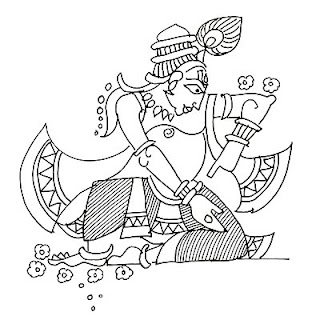
  Although Krishna is generally thought of as an adolescent, sometimes This picture follows the idea that Krishna was only 11 years old when he left Vrindavan, as stated in the Bhāgavatam: tato nanda-vrajam itaḥ pitrā kaṁsād vibibhyatā | ekādaśa samās tatra gūḍhārciḥ sa-balo’vasat || Thereafter, His father, out fear of Kaṁsa, carried Him from prison to Nanda’s Vraja. He lived there with Balarāma for eleven years, like a hidden fire. (3.2.26)

The essence of mananam is doubt

Image
A few different subjects came up on this date. (1) Devotees and learning Indian languages like Bengali and Sanskrit. I have written about this several times, like Love and Language . (2) I engaged in a response to Meena OM, a self-styled guru from Mumbai who is fairly popular " master " on Speakng Tree , where current Hinduism daily shows its blandness and abandonment of its tradition. I was posting there for a while but abandoned it quite some time ago. Anyway, about "becoming an avatar", apparently that is possible. (3) Comments on Bhaktivinoda's statement that party spirit and sectarianism are the two great enemies of progress. (4) Some verses from Govinda-līlāmr̥ta . FB Memories July 19.

Personalist Behavior

Image
Impersonalism or personalism, what is the real difference?  It is not so much in the doctrine, but in the behavior that the real test comes. The problem is projection. We see the body or the religious affiliation and so on and we don't see the soul, the person. That happens, sadly, as often if not more with people who identify themselves as theists, because they see the religious affiliation as the identifier, i.e., they see the upādhi or covering as the truth, and not the spiritual being. Now whether you call that spiritual truth Brahman or anything else, if you accept that the person with whom you are engaged is a sacred entity, and you treat them accordingly, that is personalism. Whether you do so on the level of full realization or as an aspect of sādhana . If you believe God is a bearded old man or a flute-playing cowherd, but you treat other people as objects, in whatever guṇa of nature, you are an impersonalist. Our personalist philosophy ultimately tells us to see Krishna...

Divisions of Service to Krishna (Part V)

Image
This section is a bit shorter than the previous day's offering. Here we get the specifics of dāsya according to Prīti Sandarbha 84.  Although the other sthāyi-bhāvas are described in the remaining portion of that anuccheda , in particular a long section about kānta-bhāva . The next instalment will cover Anuccheda 203ff. And then we will try to summarize. The word rati  is here being used to mean sthāyi-bhāva .

Swami Veda's antyeṣṭi and other Rishikesh memories

Image
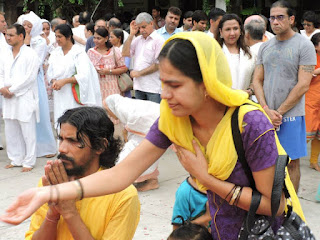
This is a photo of my friend Vishnu Panigrahi taken at the final rituals on the day of Swami Veda's jala samādhi. They were offering flowers to his body, which was about to be taken to Haridwar to be placed in the fast flowing Ganges in a place where the water was deep. Swamiji's akhara oversaw the rituals. Many people will be posting photos and videos, so I decided just to take pictures of some of the people who came. Not everybody, just the ones I recognized.  Here is my album from that day in 2015. There are other Rishikesh-related memories. FB memories July 17.   2017   One of my favorite songs. I heard this in the film Nīlācale Mahāprabhu , but the link has been lost. I did not post a translation the first time, so here it is.   ki rūpa herinu madhura mūrati pirīti rasera sāra| hena laẏa mane e tina bhūbane tulanā nāhi go tāra|| What beauty have I beheld, a form of sweetness, the essence of the taste of love It seems to me that this form has no equal anywher...