Posts

Showing posts with the label Sahaja

The Direct Meaning of Radha Krishna

Image
In the previous post I talked about śabda-vṛtti and rasa . Now in fact this was a preamble to a response to those who are confused about metaphorical interpretations of Radha and Krishna and the lila. In another earlier post ( The Two Rasa Lilas, Again ), I made a statement to the effect that Krishna was both bhagavān and the archetypal man. My friend Shivaji said that calling Krishna the archetypal man was a metaphoric interpretation. That is wrong. It is the direct statement of the shastra, even though many devotees turn a blind idea to this. To again clarify: The idea of Krishna as  bhagavān  is the Bhāgavata version. If there is a metaphorical version of Krishna lila, it is there in what the Goswamis called and rejected as the ādhyātmika interpretation. In fact, however, they cannot entirely reject the metaphorical version. It is just that they would not take the metaphorical version exclusively at the price of the literal one which the Bhāgavata makes...

Freud, Sexuality and Spirituality

Image
(continued from previous ) So is Freud relevant? Nowadays it has become the accepted wisdom that Freudianism is dead. But so many of his ideas are now considered commonsensical that it is almost a joke to reject him by name without knowing which of his ideas are still current and on what level of discourse. I could go into this in some depth, and I think that especially for devotees it would be salutary to consider these points. The relations of sexuality to love and to spirituality are the complexes that need to be decoded. I tend to accept Freud's monistic view of psychic energy, or consciousness, and not make a radical distinction between material sexuality and spirituality at all. Now this will seem counter-intuitive for those people who do make such a radical distinction. Kama andha-tama, prema nirmala bhaskara and all that. But if we say that they are generic opposites, that is erroneous. They are simply different ends of one continuum or spectrum, that of d...

Sādhāraṇī-karaṇa Revisited

Image
I mentioned sādhāraṇī-karaṇa in my poem the other day, and though it might be worthwhile to revisit the subject not only in this context, but also in the context of the discussion about Chandi Das and another post that will be coming up soon, O Mind! Meditate on Radha's Breasts . Without understanding what Rupa Goswami intended by sādhāraṇī-karaṇa , we will be severely handicapped in understanding mañjarī-bhāva , what to speak of Gaudiya Vaishnava rāgānugā sādhanā . Furthermore, a proper understanding of sādhāraṇī-karaṇa will be helpful in transcending the minefield that is the kaniṣṭha adhikārī 's confusion about myth and rational understanding. I have tried to explain these things before, but it is time to revisit the subject; hopefully I will be able to make myself clear and I hope this helps to get an insight into Rupa Goswami's concept of sādhanā . The process of identification Any such discussion has to begin with the Bhakti-rasāmṛta-sindhu , so I will quot...

Sahaja sadhana in separation

Image
One of the points that Siddhanta Saraswati liked to make in his critique of Sahajiyaism (in his generalized acceptation of the term) is that they affect union rather separation in their meditation. For Saraswati Thakur, viraha was the path to perfection shown by Chaitanya Mahaprabhu and therefore the process that should be emulated. I was not too long ago surprised to hear a Rabindra Swarup statement that manjari bhava sadhana was not integral to Gaudiya Vaishnavism, but came about as a later development as a result of association in Vrindavan with Nimbarkis and other sakhī-bhāva sampradāyas. Since we are accustomed to hearing Gaudiya Vaishnava defenses of their originating worship in sakhi or manjari bhava, I found this a rather striking commentary. Of course, something in that spirit has been floating around in the Gaudiya Math for a long time, in which one sees the argument that siddha pranali, for instance, does not exist in the writings of Rupa or the other six Goswamis, not ...

Raganuga Bhakti and Sahaja Sadhana, Part III

Image
I left off talking about association with devotees and saying that aṅga-saṅga was an element of service to a devotee. In this case, however, I did mean to place some restrictions: it is not that every bhakta is somehow to receive this kind of intimate service. It is restricted to the most antaraṅga association; and without the central element of love, it will most definitely be counterproductive. Love cannot be reduced to a mere sentiment, nor to the mere mechanics of physical sexuality. To do so is to make the same kind of mistake the beginning devotee makes when he confuses the bliss of first discovery with spiritual perfection. The love between sādhakas is the raw material of their sādhanā . But let us press on with our understanding of the compatibility of the Orthodox tradition with this way of thinking. Actually, no one has contributed to the revival of Sahajiyaism more than Bhaktisiddhanta Saraswati himself, who emphasized the concept of yukta-vairāgya . If something c...

Raganuga Bhakti and Sahaja Sadhana, Part II

Image
Now since rāgānugā bhajana focuses on the mind ( ruci-pradhānasya mārgasyāsya manaḥ-pradhānatvam—Bhakti-sandarbha , 311), its principal practice is smaraṇa . Indeed, since devotion by the inner organs is the goal, smaraṇa is said to be the objective of vaidhi bhakti also. smartavyaḥ satataṁ viṣṇur vismartavyo na jātucit sarva-vidhi-niṣedhāḥ syur etayor eva kiṅkarāḥ One must always remember the lotus feet of Lord Vishnu and never forget him for even a moment. All scriptural prescriptions and prohibitions are subservient to these two. (BRS 1.2.8, CC 2.22.113) Narottam Das expresses the same idea as follows: manera smaraṇa prāṇa, madhura madhura dhāma, yugala vilāsa smṛti sāra sādhya sādhana ei, ihā boi āra nāi, ei tattva sarva tattva sāra Meditation or remembering is the life of the mind. It is an abode of ever increasing sweetness, the essence of which is the Yugala Kishor’s vilāsa-keli , Radha and Krishna's most intimate pastimes. This is our sādhana and this is the...

Raganuga Bhakti and Sahaja Sadhana, Part I

Image
In general, I have until now primarily written for an audience of people who have some experience of bhakti, i.e., either have or have had faith in the path of devotion to Krishna. This is why I am periodically asked to defend my ideas with quotations from shastra. Now, the fact of the matter is that, amongst those who have some experience of the bhakti path, there are very few who have progressed beyond the stage of vidhi-bhakti . Even those who have gone to Narayan Maharaj or some other rasika guru, only a few have taken initiation in the rāgānugā process by receiving ekādaśa-bhāva from him. Even less in number are those who have actually taken up a serious study of the līlā-granthas and practiced aṣṭa-kāla līlā smaraṇa , even briefly, what to speak of with intensity and niṣṭhā . Of those foreign students who have either done or not done these things, there are probably even a smaller number who have learned Bengali and attended Nama kirtana yajnas or listened to lila kirtan ...

Hindu Encounter with Modernity: Sahaja samadhi

Image
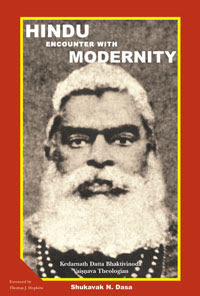
Hindu Encounter with Modernity As a result of thoughts expressed a few days ago on this blog, I decided to read through Shukavak's book again, from beginning to end this time, and review the points that he made there. I have mentioned this book many times and I would like to emphasize once again what an important contribution Shukavak has made to the future of the sampradaya by opening the door to this aspect of Bhaktivinoda's thought, which Bhaktivedanta, by inadvertance or by design, decided to omit from his own preaching. I wrote in Bhaktivinoda Thakur's meat eating and Lalita Prasad Thakur that Bhaktivinoda Thakur made two most significant contributions: the first is the opening of a door to a modern approach to Gaudiya Vaishnava doctrine and history, the other is the wholehearted acceptance of the raganuga sadhana practices that are generally rejected by all branches of the Gaudiya Math. Shukavak quotes several times a passage from the introduction to the Krish...